
My talk explored the intersection of AI, cultural understanding, and human flourishing, emphasizing how technology should enhance human innovation rather than drive it. I discussed the challenges in measuring flourishing across diverse cultures and the importance of moving beyond Western-centric models of success.
My presentation focused on the limitations of relying on WEIRD samples in research on human cognition and behavior, and the need to move beyond these populations. I shared new data from my research in Namibia and Angola, drawing on the framework from my book, A Theory of Everyone, to emphasize the importance of strategic sampling based on theory and cultural distance.
In the talk, I also discussed best practices for cross-cultural research, including the use of online tools like Besample, cross-cultural collaborations, and considerations for field research.
My deepest thanks to the Max Planck Institute of Human Development for inviting me and organising the event.
Some of my relevant papers on the topic can be found here:
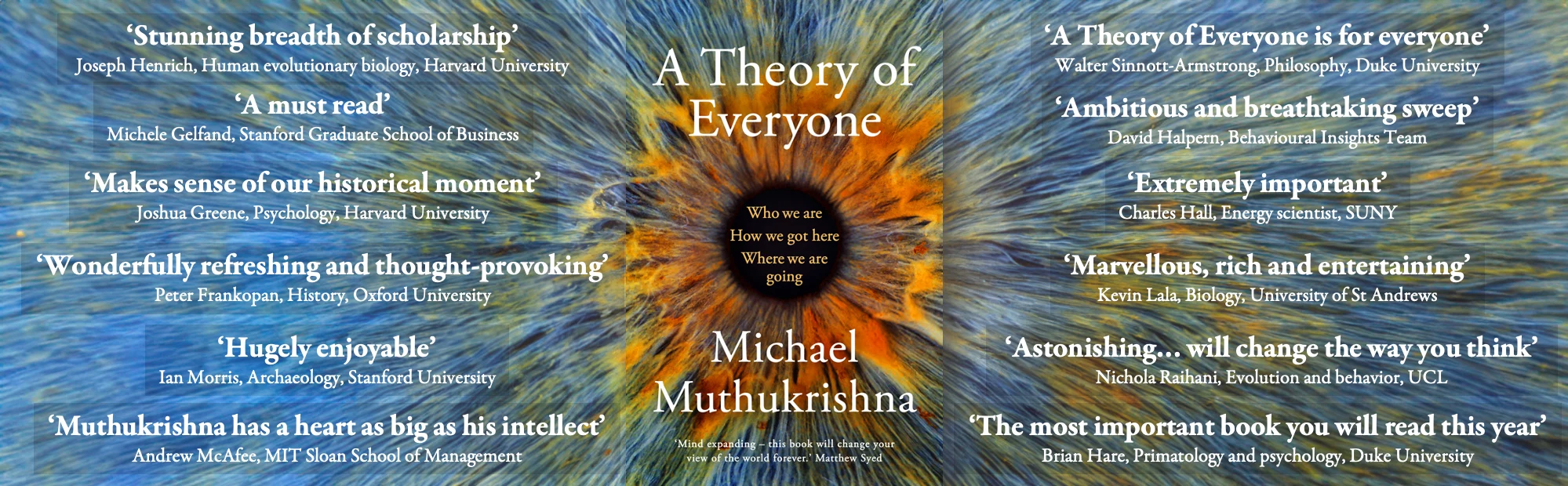
Muthukrishna, M. (2023). [BOOK] A Theory of Everyone: Who we are, how we got here, and where we’re going. MIT Press (US & Canada) / Basic Books (UK and Commonwealth) [Amazon and Local Bookstores]
Muthukrishna, M., Bell, A. V., Henrich, J., Curtin, C., Gedranovich, A., McInerney, J. & Thue, B. (2020). Beyond Western, Educated, Industrial, Rich, and Democratic (WEIRD) Psychology: Measuring and Mapping Scales of Cultural and Psychological Distance. Psychological Science, 31(6), 678-701. [Download] [Supplementary] [Code] [Summary Post] [Publisher] [Twitter]
Slingerland, E., Atkinson, Q. D., Ember, C. R., Sheehan, O., Muthukrishna, M., Bulbulia, J. & Gray, R. D. (2020). Coding Culture: Challenges and Recommendations for Comparative Cultural Databases. Evolutionary Human Sciences, 2, E29. [Download] [Publisher]
In my presentation, based on the concepts from my book, A Theory of Everyone, I discussed the ongoing scientific revolution transforming the psychological and behavioral sciences. I also discussed how the dual inheritance theory provides a comprehensive framework for understanding human behavior and its applications in real-world interventions and policy.
My deepest thanks to the ACBS for inviting me and organising the event, and to Lori E. Crosby, Mavis Tsai and her team for their insightful talks and workshop.
I was invited to talk at the Charter Cities Week in Fumba Town, Zanzibar.
I explored the themes from my book, A Theory of Everyone, focusing on how startup cities like Fumba Town can catalyze economic and social development. I discussed the critical interplay of culture, psychology, and economics in shaping urban projects, emphasizing the role of cultural and psychological insights as foundational elements in designing and building new urban environments.
The full talk can be found here, and you can check out my book here.
This month, I was invited to deliver a keynote at the Global Solutions Summit by the World Policy Forum to the G20 and G7, on “Paradigm Shift: Reorienting Economics and Economic Policy Solution Dialogues”.
My talk focused on rethinking economic frameworks for the G20 nations, highlighting the need for a new paradigm that addresses global challenges like inequality and political instability.
I was invited to deliver a keynote address at the Rebuilding Macroeconomics conference on Polycrises and Policy Frameworks. In my talk, I explored how human evolution, shaped by both genetic and cultural factors, has contributed to our ability to address complex challenges. I focused on my research on cultural transmission, and how it enables humans to innovate, cooperate, and respond to crises.
The talk also included an insightful discussion between myself, speakers Clara Mattei and Alan Kirman. Those interested can view the full discussion here.
April 30 – May 1, 2025: Invited speaker at the Behavioural Exchange Conference, Behavioral Science Group at the Office of Development Affairs, Abu Dhabi, UAE
January 15, 2025: Invited talk at the Centre for Culture and Evolution, Brunel University, London
December 3, 2024: Invited talk at Google
October 18, 2024: Invited talk at Department of Economics, Stellenbosch University, South
October 3-8, 2024: Keynote speaker at Khazanah Megatrends Forum, Khazanah Nasional Berhad (Malaysian Sovereign Wealth Fund), MalaysiaAfrica
September 25, 2024: Invited speaker at the 2024 Wallace Wurth Lecture, University of New South Whales, Sydney, Australia
June 3-4, 2024: Cohesive Capitalism Summit, London School of Economics
April 11-12, 2024: Invited speaker at workshop on “An Aspirational Approach to Planetary Futures” by the UNDP Human Development Report Office, Oxford
April 8, 2024: Invited speaker at Booth School of Business, The University of Chicago.
March 9-11, 2024: Meeting on Comity, London School of Economics
My talk on Data-Driven Discovery, focused on how to conduct research using existing datasets. I discussed strategies for finding and analyzing datasets effectively, emphasizing the potential of computational methods to uncover new insights in psychology through large-scale data analysis.
I also participated as a panelist at the conference. In the roundtable, we addressed equitable collaborations and the inclusion of researchers from the Global South in social psychology. The session included discussions on barriers, opportunities, and methodologies relevant to fostering global research.
My thanks to Arathy Puthillam for chairing the event, to the SPSP organizers for the opportunity, and to everyone who attended for their engaging questions and discussions.
Muthukrishna, M., Henrich, J. & Slingerland, E. (2021). Psychology as a Historical Science. Annual Review ofPsychology, 72, 717-49. [Download] [Publisher] [Summary Post] [Twitter]
I gave a talk at the “Emotions in History: Boundary-Crossing Adventures” workshop, hosted by the University of California, Santa Barbara (UCSB). This symposium brought together experts from the fields of psychology and history to explore the interplay between emotional theories across these disciplines.
The talk also included a wonderful roundtable discussion.
For those interested, you can watch the recordings of this event, accessible here. My deepest thanks to UCSB and the organizers, Hongbo Yu and Ya Zuo.
As the Co-founder and Technical Director of the DRH, I’m excited about the collaborations and applications of recent advancements and the integration of novel methodologies in the study of religious history.
Muthukrishna, M. (2023). [BOOK] A Theory of Everyone: Who we are, how we got here, and where we’re going. MIT Press (US & Canada) / Basic Books (UK and Commonwealth) [Amazon and Local Bookstores]
Schnell, E., Schimmelpfennig, R., & Muthukrishna, M. (2023). The Size of the Stag Determines the Level of Cooperation. bioRxiv
Muthukrishna, M., Henrich, J. & Slingerland, E. (2021). Psychology as a Historical Science. Annual Review ofPsychology, 72, 717-49. [Download] [Publisher] [Twitter]
Henrich, J. & Muthukrishna, M. (2021). The Origins and Psychology of Human Cooperation. Annual Review ofPsychology, 72, 207-40. [Download] [Publisher] [Twitter]
The title of my talk was “The Evolution of Comity: Ultimate Constraints on the Scale of Cooperation.” Key publications relevant to this discussion are:
The research is related to my book, and a grant focused on expanding our comprehension of the foundational processes facilitating cooperation, with the goal of enhancing social harmony and unity. I am grateful to the faculty, students and staff at Mohammed VI Polytechnic University for the invitation and their hospitality.
I spoke about “Mapping Psychological Terrae Incognita:Explorations Beyond WEIRD Psychology”, which primarily focused on these papers:
Muthukrishna, M., Bell, A. V., Henrich, J., Curtin, C., Gedranovich, A., McInerney, J. & Thue, B. (2020). Beyond Western, Educated, Industrial, Rich, and Democratic (WEIRD) Psychology: Measuring and Mapping Scales of Cultural and Psychological Distance. Psychological Science, 31(6), 678-701. [Download] [Supplementary] [Code] [Summary Post] [Publisher] [Twitter]
White, C. J. M., Muthukrishna, M. (equal senior) & Norenzayan, A. (2021). Worldwide evidence of cultural similarity among co-religionists within and across countries using the World Values Survey. Proceedings of the National Academy of Sciences, 118 (37) e2109650118. [Download] [Supplementary] [Publisher] [Twitter]
Muthukrishna, M., Henrich, J. & Slingerland, E. (2021). Psychology as a Historical Science. Annual Review ofPsychology, 72, 717-49. [Download] [Publisher] [Summary Post] [Twitter]
Muthukrishna, M., Doebeli, M., Chudek, M., & Henrich, J. (2018). The Cultural Brain Hypothesis: How culture drives brain expansion, sociality, and life history. PLOS Computational Biology, 14(11): e1006504. [Download] [Supplementary] [Summary Post] [Publisher] [Twitter]
Schimmelpfennig, R., Razek, L., Schnell, E., & Muthukrishna, M. (2021). Paradox of Diversity in the Collective Brain. Philosophical Transactions of the Royal Society B: Biological Sciences. [Download] [Summary Post] [Publisher] [Twitter]
The fifth Future of Government Disruptive Debate hosted by the World Bank tackles the issue of citizens’ trust in government. Together with a diverse group of high-profile practitioners, renowned experts, and thought leaders, I discuss how the natural state of affairs is corruption and the challenges government face in getting citizens to trust higher levels of cooperation.
My opening remarks can be found from 7:12 to 14:07 in the recording above. A rough summary of my talk can be found on my substack: https://muthukrishnalab.substack.com/p/trust-governance-and-cultural-evolution
The fifth Future of Government Disruptive Debate will tackle the issue of citizens’ trust in government. The Disruptive Debate series aims is to bring together a diverse group of high-profile practitioners, renowned experts and thought leaders to generate new knowledge and perspectives.
The issue of trust has been a frequent theme arising during the Disruptive Debate series. The panel addressed questions such as: Why is trust important for poverty reduction and shared prosperity? What is the relationship between inequality and trust? What can governments do to increase, or re-build, trust? How can citizens influence and hold governments to account? What has been the role of information, data and social media, particularly during COVID-19?
Ted Slingerland, M. Willis Monroe, and I were awarded a John Templeton Foundation grant for The Database of Religious History: “Exploring the Cultural Evolution of Religion Employing a Large-Scale, Quantitative-Qualitative Historical Database” ($4,792,151). The grant will take us through to 2023.
We will be hiring several new postdocs to expand the time depth, geographic range, and domains of data collection efforts. If you notice your area of expertise missing from our dataset, please reach out. Otherwise, stay tuned for job ads.
I recently helped the UK Home Office with their anti-corruption, #FlagItUp campaign to encourage accounting and legal professionals to report more suspicious through a suspicious activity report.
MoneySupermarket approached me for their Hotel of Mum and Dad campaign about the question of why it’s so difficult for young people to buy a house today. There are many proximate-level economic and social factors to answer this question, but an ultimate-level explanation lies in an extension of our juvenile period – a process that’s been occurring since we became human. The research on this is summarized under the Cultural Brain Hypothesis and Collective Brain. A discussion on Sky News and a copy of the article below:
Sky News interview where I discuss the trend of adults moving back home with their parents and how this links to the Cultural Brain Hypothesis, collective brain, and ever extending juvenile periods.
As parents, we might summarise our role as the three Ps: To Protect, to Provide, and to Prepare. But when our children face an ever-changing, more complex and more challenging world than we faced, how do we prepare our children so that they can provide for and protect themselves? And what happens when life happens, and they need to return home?
There is a trend of adult children moving back in with their parents to save money, at the expense of their privacy and independence.
At an individual level, these decisions are often made with changing life circumstances – health, divorce, losing a job, increases in rent, conflict with flatmates and so on. But there are often broader societal trends underlying these decisions.
The first is a long term trend that has affected humans since the beginning of our species – what scientists call our ‘extended juvenile period’.
Every profession now has to deal with new technologies and more complex systems. This has resulted in us spending more time in education, particularly on-the-job education (e.g. internships, junior roles and lower paid apprenticeships), meaning it now takes more time before we’re earning enough to support a family, buy a house and become self-sufficient.
It used to be that a high school diploma was enough to make a good living. Then it took a university degree or a short apprenticeship. Now it requires post-graduate degrees, internships and volunteer work – which can be unpaid – as well as on-the-job training.
This has meant that the age of first birth, the age of owning a home and the age of financial independence have been steadily rising. As a result, when the last two generations did finally leave home, they often found themselves needing to return, especially if they were unable to share costs with a partner or group of friends.
The second trend is more recent. Economic growth has slowed, yet wealth and income inequality has risen. In combination, this means there’s less to go around per person and of what is there, a greater share has gone to the top end of society.
This means it’s becoming more difficult for people to purchase a home and become self-sufficient than it was for their parents, or even those born a couple of decades earlier.
These are real problems with not-so-simple solutions.
However, it can be hard to see an adult child return home in less than ideal circumstances, especially after two decades of interrupted sleep, changing nappies, helping with homework, giving them lifts from event to event, dealing with the ups and downs of friendships and first romantic relationships, and celebrating the joys, achievements, graduations and first jobs.
For children too, this is often not a preferred situation. They are trading their independence and privacy for financial savings and perhaps some home cooking and laundry.
There are no one-size-fits-all solutions on how to handle the new situation, but it may be worth noting a few things in moving toward a more open discussion:
Emotions such as pride and sense of self-worth are affected on both sides – A child in their ability to handle the world as their parents did, and a parent in whether they properly prepared their children for the world. These may lead to important discussions, but it’s important to remember that the world is more competitive for young adults than ever before.
Different societies and different cultures have different expectations for independence – In many so-called WEIRD (Western Educated Industrialised Rich Democratic) societies, young adults are expected to live alone or apart from their parents. However, in many other societies, unmarried children live with their respective parents until marriage and then married couples live with or near their husband (patrilocal) or wife’s (matrilocal) parents. It may be that our society is moving toward these other norms.
There are pros and cons for both parents and children that vary from family to family, and circumstances outside of the family also affect emotions and mental health – In discussing how long the arrangement will last and how to keep both parties happy, it’s worth remembering the costs and benefits to both parties. On both sides, this can come in the form of increased support at home, the joy of being closer to loved ones and perhaps access to grandchildren, versus the loss of privacy, increased workload, reduced living space and financial costs. An honest conversation can help prevent problems from surfacing in less ideal ways.
Thankfully, many parents have been willing to help their children reduce their expenses by moving back home – even though research has shown the tensions over how much children should be contributing in rent and expenses, and the mismatch in expectations between parents and children.
Hopefully, even if the returns to parents aren’t immediately monetary, they find that their children do eventually become financially self-sufficient and perhaps return the favour as they grow older.